
WHS & Psychosocial Safety
Organisations today face increasing expectations to create environments where people feel psychologically safe, respected, and supported. Psychosocial safety is no longer optional — it is now embedded in WHS legislation and global standards for healthy work.
THRYVE Org™ helps organisations strengthen culture, leadership behaviour, communication, and wellbeing in ways that support psychosocial safety and align with WHS obligations — without replacing legal WHS consulting or compliance auditing.
Understanding Psychosocial Hazards
Psychosocial hazards are aspects of work that can negatively affect mental health, wellbeing, and performance. Examples include:
excessive or unclear workload
lack of role clarity
interpersonal conflict or poor behaviours
inadequate support or recognition
low autonomy
inconsistent communication
organisational change pressures
emotionally demanding work
values misalignment
Strengthening culture and leadership capability is essential for managing these risks effectively.
Our Role in WHS & Psychosocial Safety
-
leadership behaviours
role clarity
communication patterns
interpersonal dynamics
values alignment
team collaboration
change and workload pressures
-
This work aligns with WHS expectations for managing psychosocial hazards, while remaining firmly in the domain of organisational wellbeing, behaviour, and culture transformation.
Our work helps organisations address the cultural and behavioural drivers of psychosocial risk through evidence-based, people-centred approaches:
✔ Identify cultural pressures
Using validated tools, sector-tailored surveys, interviews, and data analysis.
✔ Build leadership capability
Supporting leaders to strengthen clarity, communication, fairness, and psychological safety.
✔ Improve team and organisational dynamics
Clarifying expectations, reducing friction, and supporting respectful daily practice.
✔ Support wellbeing and prevent burnout
Promoting clarity, collaboration, and sustainable pace of work.
✔ Align culture with WHS expectations
Helping organisations move toward proactive, prevention-oriented approaches to workplace wellbeing.
How THRYVE Org Supports Psychosocial Safety
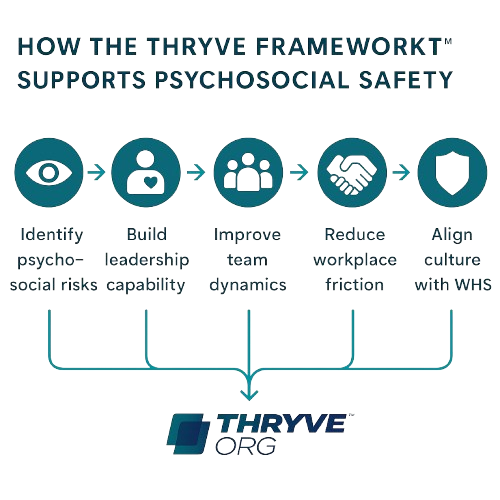
These supports form part of the THRYVE Framework™ Pathway Program, a structured fractional partnership that promotes long-term wellbeing and cultural transformation
Alignment With WHS Principles (Non-Legal)
-
Safe Work Australia — Psychosocial Hazards
Comcare — Mentally Healthy Workplaces
ISO 45003 — Psychological Health & Safety at Work
National Mental Health Commission — Workplace Blueprint
-
prevention
leadership capability
clear communication
respectful behaviour
supportive systems
early identification and response
THRYVE Org’s services help organisations strengthen these foundations through evidence-informed cultural and leadership practices.
Key WHS Resources
Safe Work Australia
Psychosocial Hazards & WHS Duties
Guidance on identifying, assessing, and managing psychosocial risks.
Comcare
Mentally Healthy Workplaces
Practical advice on prevention, leadership, and early support.
National Mental Health Commission
Blueprint for Mentally Healthy Workplaces
Best-practice guidelines for leaders and decision-makers.
ISO 45003
Psychological Health & Safety Standard
The global benchmark for managing psychosocial risks.
Important Note (Disclaimer)
The information on this page is for general educational purposes only and does not constitute legal advice.
THRYVE Org™ supports organisations to strengthen culture, leadership practices, communication, and wellbeing in alignment with WHS principles.
Organisations should seek legal advice or consult their WHS regulator for guidance specific to their obligations.